




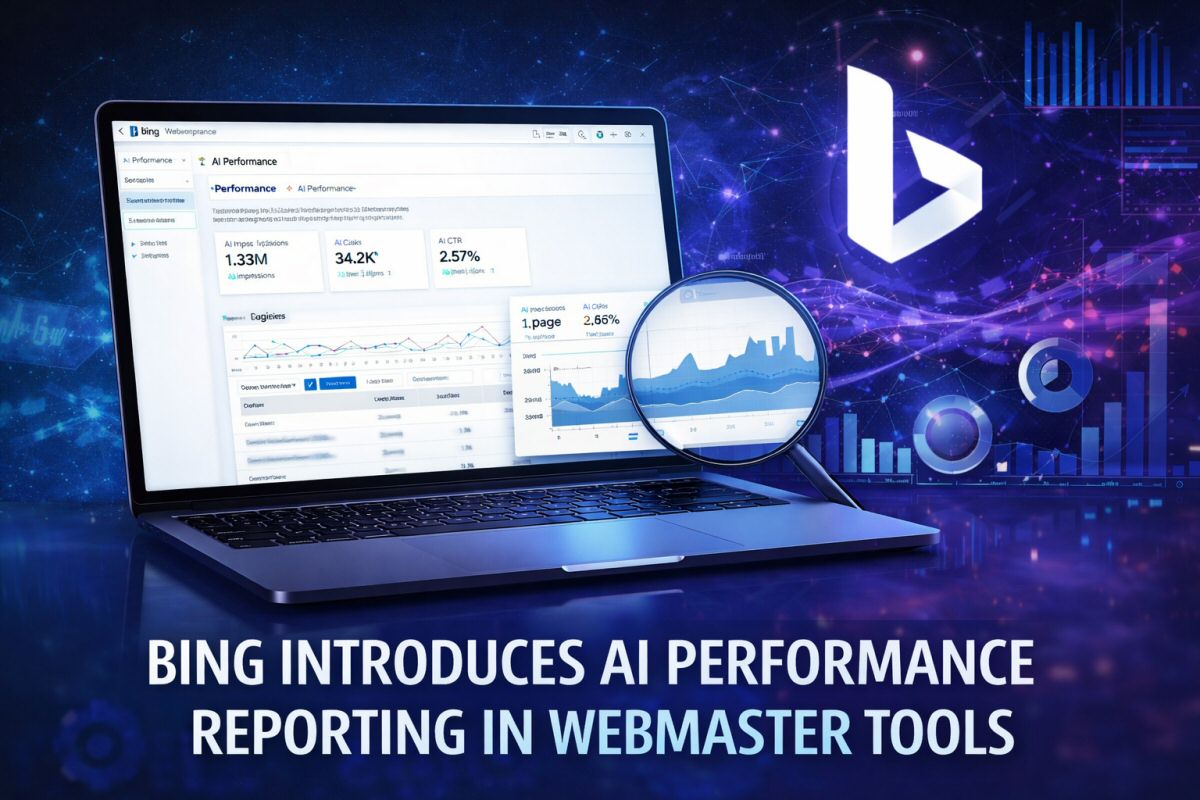
Microsoft just gave publishers something Google hasn’t: dedicated AI citation tracking. The new AI Performance dashboard in Bing Webmaster Tools, now in public preview, lets website owners see exactly how their content is being cited across Microsoft Copilot, Bing’s AI-generated summaries, and select partner integrations.
This is a significant step toward what the industry is calling Generative Engine Optimization (GEO) — and it puts Bing ahead of Google Search Console in one critical area.
What the AI Performance Dashboard Shows
For the first time, publishers can track how often their content is cited in AI-generated answers — with clear visibility into which URLs are referenced and how citation activity changes over time.
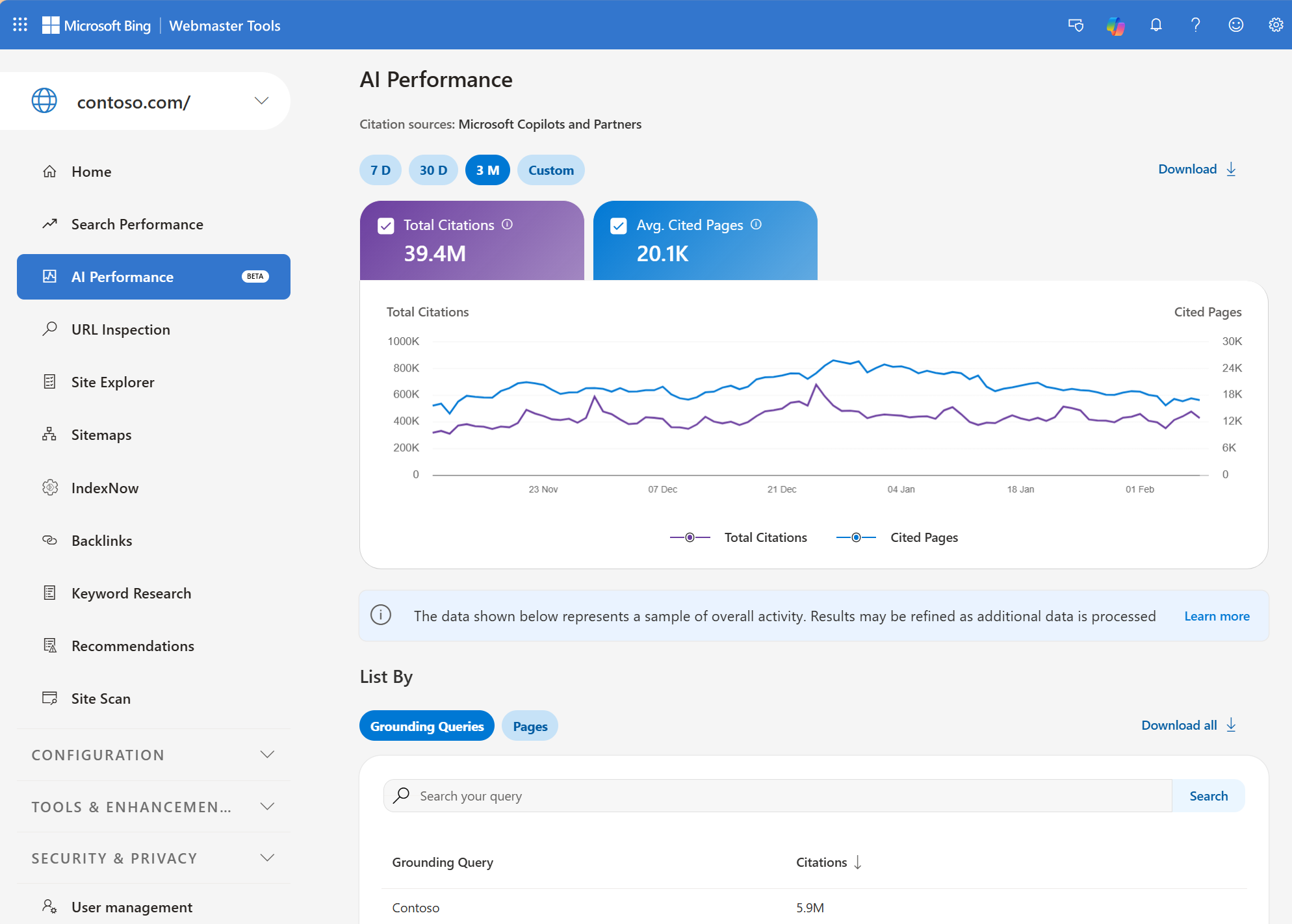
The dashboard surfaces five key metrics:
- Total Citations — How many times your site is cited as a source in AI-generated answers during a selected period
- Average Cited Pages — The daily average number of unique URLs from your site referenced across AI experiences
- Grounding Queries — Sample query phrases AI systems used to retrieve and cite your content
- Page-Level Citation Activity — Citation counts by URL, highlighting which pages are referenced most often
- Visibility Trends Over Time — A timeline view showing how citation activity rises or falls across AI experiences
Why This Matters for Publishers
As AI-powered search continues to reshape how users find information, a growing share of traffic is being mediated through AI-generated answers rather than traditional blue links. The problem? Until now, publishers had virtually no visibility into whether their content was being used by AI systems — or how often.
Bing’s AI Performance dashboard changes that equation. Publishers can now:
- Confirm which pages already serve as references in AI answers
- Identify high-performing topics that consistently appear across AI-generated responses
- Spot improvement opportunities for indexed content that isn’t getting cited
This kind of data is essential as the industry shifts from traditional SEO toward GEO — where the goal isn’t just ranking on a search results page, but being cited as a source in AI-generated answers across platforms like Copilot, ChatGPT, and Google Gemini.
Bing vs. Google: Who’s Ahead on AI Transparency?
Here’s where it gets interesting. Google’s Search Console integrates AI Overviews and AI Mode into its overall Performance reporting, but it lacks dedicated citation tracking or page-specific URL counts for AI-generated answers.
Bing’s offering is more granular. You can see which specific pages receive citations, how frequently they’re cited, and what query phrases triggered those citations. This level of transparency gives Bing Webmaster Tools a clear edge for publishers trying to understand their AI visibility.
As we’ve covered, the shift from giant AI models toward applied, agentic AI is accelerating — and search is one of the most affected domains. Tools like this dashboard will become essential for anyone creating content in the AI era.
How to Optimize for AI Citations
Microsoft recommends five strategies for improving your content’s chances of being cited in AI answers:
- Strengthen expertise — Go deeper on your topics. AI systems favor comprehensive, authoritative content over surface-level coverage
- Improve clarity — Use clear headings, tables, and FAQ sections. Structured content is easier for AI to parse and cite
- Support claims with data — Include examples, statistics, and citations. AI systems look for verifiable, well-sourced information
- Keep content current — Regular updates signal relevance. Use IndexNow to notify search engines of changes instantly
- Reduce ambiguity — Align text, images, and video to deliver a consistent, clear message
IndexNow: Accelerating AI Content Discovery
Alongside the AI Performance dashboard, Microsoft highlighted IndexNow as a key companion tool. IndexNow is a free, open-source protocol that instantly notifies search engines when content is added, updated, or deleted — without waiting for traditional crawling cycles.
This is particularly important for AI citations. If your content is outdated when an AI system references it, the citation may be inaccurate or harmful to your brand. IndexNow ensures AI systems always have access to the most current version of your content.
What About Local Businesses?
Microsoft also pointed to Bing Places for Business as an important tool for local businesses looking to appear in AI-generated answers. Keeping your business information accurate — address, hours, contact details — helps AI systems provide reliable answers to location-based queries.
Limitations to Keep in Mind
The AI Performance dashboard is still in public preview, and Microsoft notes some important caveats:
- Metrics track citation frequency only — they don’t reveal ranking prominence, click-through data, or direct traffic impact
- Grounding queries represent a sample of overall activity, not the complete picture
- Data may be refined as additional processing occurs, so numbers could shift over time
- The dashboard currently covers Microsoft Copilot, Bing AI summaries, and select partners — not all AI platforms
That said, even partial data is better than no data, which is what most publishers have had until now.
How to Access the AI Performance Dashboard
The new feature is available now in Bing Webmaster Tools. If you already have a verified site, you’ll find “AI Performance” in the left navigation menu. If you’re new to Bing Webmaster Tools, you can verify your site using DNS, CNAME, or meta tag methods.
For developers and technical SEO teams, this dashboard pairs well with Bing’s existing Site Scan feature for technical audits, Robots.txt Tester, and the URL Inspection tool — giving you a complete picture of how your site performs in both traditional and AI-driven search.
The Bottom Line
The rise of AI-generated answers is fundamentally changing how content gets discovered and consumed. Microsoft’s AI Performance dashboard is the first major tool that gives publishers real data about their visibility in this new paradigm.
Whether you’re running a news publication, an e-commerce site, or a SaaS blog, understanding your AI citation performance is no longer optional — it’s becoming as essential as tracking your traditional search rankings. With ChatGPT, Claude, and Copilot all competing for user attention, the publishers who track and optimize for AI visibility will have a significant advantage.
Welcome to the era of Generative Engine Optimization.