





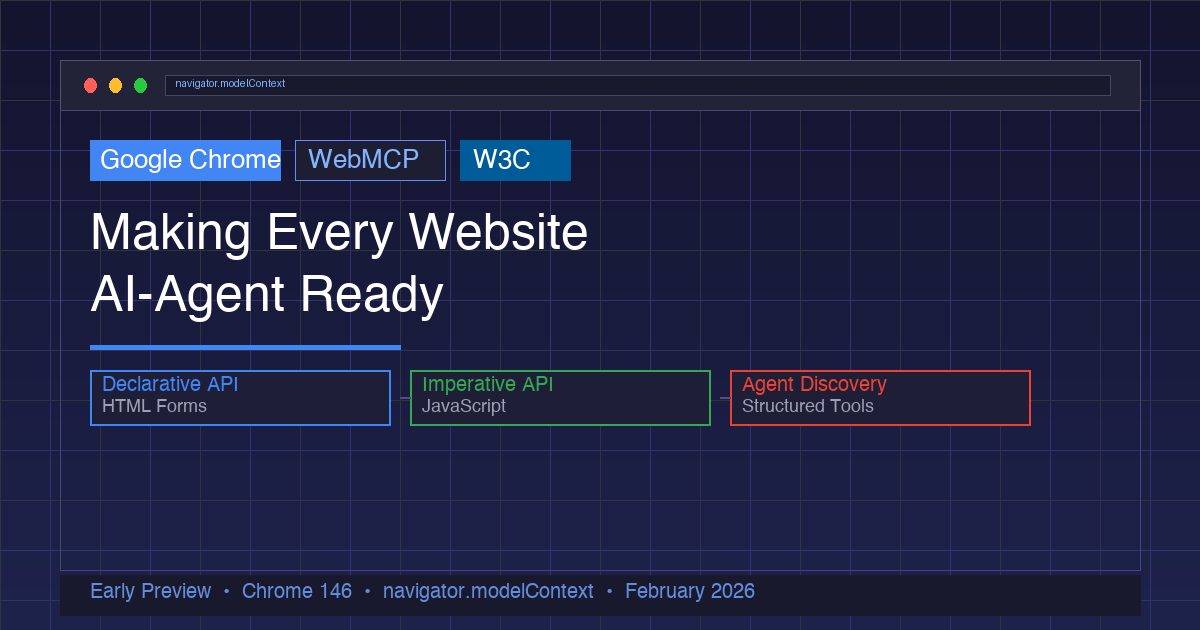
Google Chrome has released an early preview of WebMCP, a proposed web standard that lets any website expose structured, callable tools directly to AI agents through a new browser API. Developed jointly by engineers at Google and Microsoft and incubated through the W3C’s Web Machine Learning community group, WebMCP introduces navigator.modelContext — a client-side API that turns ordinary web pages into agent-ready tool providers without requiring back-end infrastructure changes.
What Problem Does WebMCP Solve?
As AI agents become increasingly capable of performing tasks on behalf of users — booking flights, filing support tickets, navigating complex datasets — they face a fundamental problem: websites were designed for humans, not machines. Agents currently rely on scraping the DOM, guessing at UI elements, and simulating clicks, which is slow, fragile, and error-prone.
WebMCP solves this by letting websites explicitly define what actions are available, what inputs they require, and what outputs they return. Instead of reverse-engineering a webpage, an AI agent can discover structured tools, call them with properly typed parameters, and receive clean data back. This is similar in spirit to how llms.txt aims to make website content readable for AI models, but WebMCP goes further — it enables agents to act, not just read.
Two APIs: Declarative and Imperative
WebMCP proposes two complementary approaches for exposing tools to agents, giving developers flexibility based on their use case:
Declarative API (HTML Forms)
The simplest way to make a website agent-ready is by annotating existing HTML forms with new attributes. The browser automatically translates form fields into tool schemas that agents can discover and invoke:
<form toolname="searchFlights"
      tooldescription="Search available flights by route and date">
  <input name="origin" type="text" required />
  <input name="destination" type="text" required />
  <input name="date" type="date" required />
  <button type="submit">Search</button>
</form>
Adding the toolautosubmit attribute allows agents to submit forms directly without requiring user confirmation for each action.
Imperative API (JavaScript)
For more complex, dynamic interactions, developers can register tools programmatically using the new navigator.modelContext API:
navigator.modelContext.registerTool({
  name: 'searchFlights',
  description: 'Search available flights by route and date',
  inputSchema: {
    type: 'object',
    properties: {
      origin: { type: 'string', description: 'Departure airport code' },
      destination: { type: 'string', description: 'Arrival airport code' },
      date: { type: 'string', description: 'Travel date' }
    },
    required: ['origin', 'destination', 'date']
  },
  execute: async (params) => {
    const results = await searchFlightsAPI(params);
    return { content: [{ type: 'text', text: JSON.stringify(results) }] };
  }
});
This approach provides full control over inputs, outputs, and execution logic — ideal for applications that go beyond simple form submissions.
WebMCP vs. Anthropic’s Model Context Protocol
Despite sharing a portion of its name, WebMCP is not a replacement for Anthropic‘s Model Context Protocol (MCP). The two operate at different layers:
- MCP is a back-end protocol that connects AI platforms to service providers through hosted servers, using JSON-RPC for client-server communication
- WebMCP operates entirely client-side within the browser, letting websites expose tools directly to agents visiting the page — no separate server infrastructure required
For web developers, this is a significant distinction. Instead of building and maintaining separate MCP servers in Python or Node.js, teams can wrap their existing client-side JavaScript logic into agent-readable tools without re-architecting their applications.
Security: Browser-Mediated by Design
WebMCP builds security into its architecture through several mechanisms:
- Browser-mediated execution — All tool calls route through the browser, not directly from agent to page
- User review — Users can review which tools agents access before granting permission
- Manual submission by default — Forms require explicit user confirmation unless
toolautosubmitis set - Agent detection — A new
SubmitEvent.agentInvokedboolean flag lets developers distinguish agent submissions from human ones - Interaction gates —
agent.requestUserInteraction()enables mid-execution confirmation for sensitive actions - Sequential execution — Tool calls execute one at a time, preventing simultaneous conflicting actions
Developer Tooling
Chrome ships several tools alongside WebMCP to help developers build and debug agent-ready websites. For developers already working with AI-powered coding tools, these additions integrate into existing workflows:
- Chrome DevTools WebMCP panel — A dedicated panel for inspecting registered tools, debugging schema errors, and monitoring failed calls
- CSS pseudo-classes —
:tool-form-activeand:tool-submit-activeprovide visual feedback when agents interact with forms - Model Context Tool Inspector — A Chrome Web Store extension for testing and viewing registered tools on any page
Real-World Use Cases
WebMCP targets three primary categories of web interaction:
- E-commerce — Product discovery, configuration, cart management, and checkout with structured data accuracy instead of DOM scraping
- Travel — Flight searching, filtering, seat selection, and booking through well-defined tool schemas
- Customer support — Automated population of technical details in support tickets, guided troubleshooting flows, and issue categorization
What This Means for Publishers and Web Developers
WebMCP represents a significant shift in how websites will interact with AI systems. For publishers already adapting to AI-driven search — as seen with tools like Bing’s new AI Performance Dashboard — WebMCP adds another layer: websites that don’t expose structured tools may become invisible to the growing ecosystem of AI agents.
The standard also reflects a broader trend in the machine learning landscape, where the focus is shifting from model intelligence alone to the infrastructure that connects AI systems with the real world. WebMCP is the web’s answer to that infrastructure gap.
Availability and Timeline
WebMCP is currently available in Chrome 146 Canary behind the “WebMCP for testing” flag at chrome://flags. Developers can sign up for the early preview program to gain access to documentation, demos, and API updates. The stable release in Chrome 146 is expected around March 10, 2026, with broader announcements likely at Google Cloud Next and Google I/O later this year.
For web developers building sites that will need to serve both human users and AI agents, now is the time to start experimenting. The declarative HTML approach means you can begin testing with minimal code changes — just a few attributes on your existing forms.
Source: Chrome for Developers — WebMCP Is Available for Early Preview